What is write for rights?
Every year, in honor of Human Rights Day on December 10, people across the globe come together through Write for Rights, Amnesty International’s largest human rights campaign.
Hundreds of thousands of people write letters, send messages of solidarity, and sign petitions on behalf of individuals they have never met. These simple acts of compassion and courage send a powerful message: no one stands alone when their rights are under attack.
For more than 65 years, Amnesty International’s letter-writing campaigns have helped free prisoners of conscience, protect human rights, and transform lives. Together, our actions show that people power works.
How it works

- Amnesty identifies cases—including of Prisoners of Conscience, human rights defenders, torture survivors, and communities at risk—where global activism can make a huge impact.
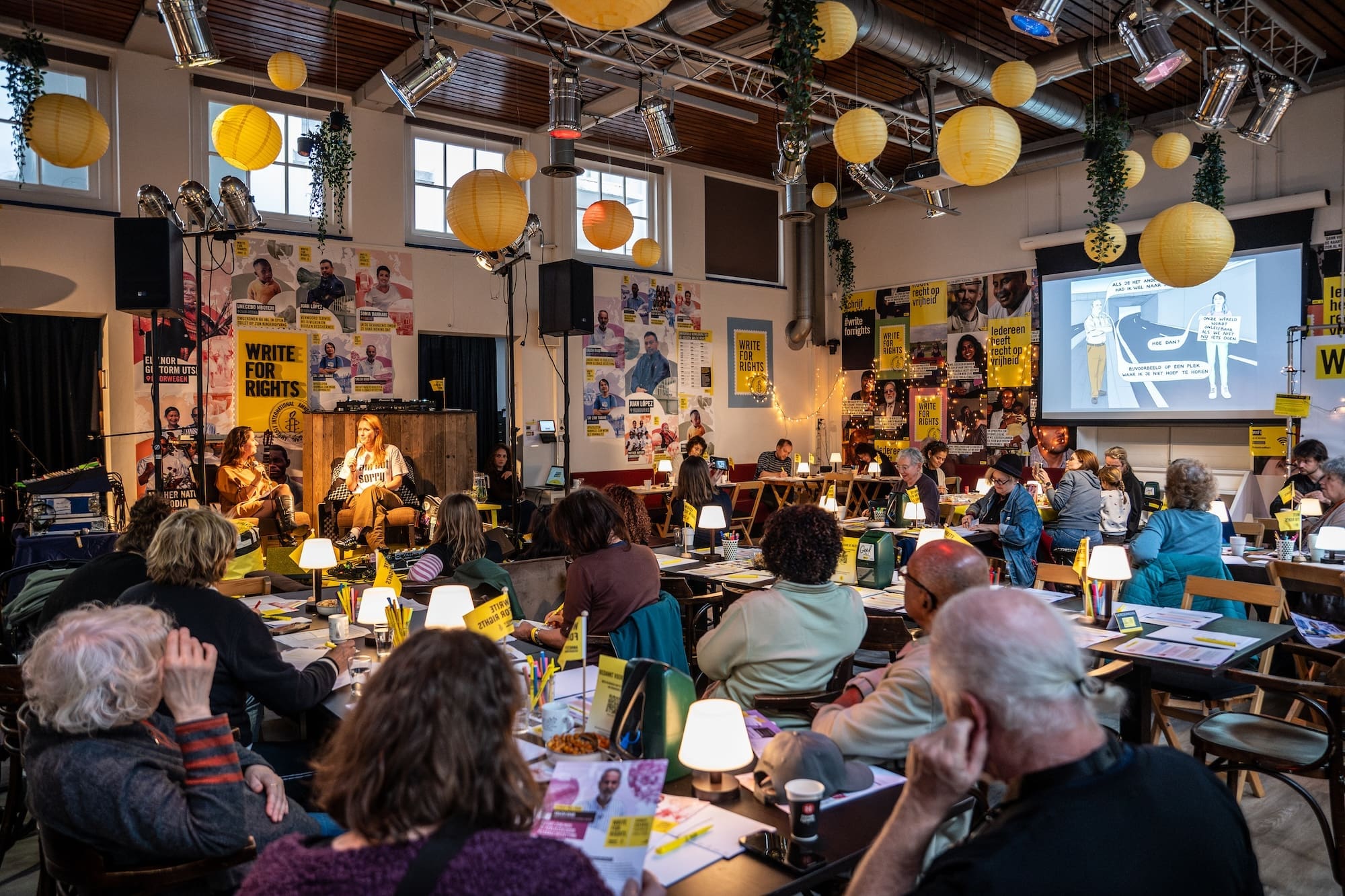
- People like you organize letter-writing events, join events, or write on their own in order to generate as many letters on those cases as possible.
- Letters and online petitions arrive at government offices and are sent to prison cells and to families all over the world.
- Change happens. Hope grows. As messages flood mailboxes, prisoners’ conditions improve, or they are released. Human rights defenders are better protected. Torture stops. Executions are halted.
- Participants like you report their letters to let us know how many were sent on behalf of each case. We use that information in our advocacy, and share it with the individuals themselves—and with you.
WAYS To TAKE ACTION
Write letters on your own
Planning to write letters on your own? Click the button below to find useful resources to help you plan and write.
Write With Students and Youth
Explore resources to encourage students and youth to learn about human rights and make their voices heard.
Find a LEtter Writing Event Near You
Complete this form if you would like to be contacted about upcoming letter writing events in your area.
Host a Letter Writing event
Submit this form to register your event and become a contact for others in your area who are looking for events to join.
Show where Events are happening!
Whether you are writing letters individually, with your students, or as part of an event, you can add your region to our national map!
Report Your letters
Don’t forget to report your actions! We share the number of people around the world taking action, but we need your help to do it.
Your Words are Powerful
- People in more than 200 countries and territories take part in all kinds of events
- Writing millions of letters, emails and tweets and signing petitions
- Supporting people whose rights have been violated
- Putting pressure on governments, leaders and decision makers
- Showing love and support for people and their families
- And making change happen – releasing activists, securing justice for those whose rights have been wronged and protecting people who fight for change

History of Write for Rights
Write for Rights is the world’s largest human rights event, but it has humble origins. Over twenty-five years ago, a man named Witek met a woman named Joanna at a festival in Warsaw, Poland. Joanna had just returned from traveling through Africa, where she’d seen activists organizing 24-hour events to write protest letters to governments.
Witek invited Joanna to join a meeting of his local Amnesty group. Together, they wrote Urgent Action appeals for 24 hours straight. When they emailed their idea to other Polish groups, it turned into something much bigger, bringing together activists across the country. Then, their idea went viral.
Witek and Joanna emailed Amnesty offices across the world, and people started sending back pictures of themselves writing letters – in Niagara Falls, in Japan, in Mongolia. It was a spontaneous, grassroots initiative that grew and grew.
Every December since, Write for Rights has inspired hundreds of thousands of people to write letters to distant governments. Some still do it Polish-style, over a hectic, sleepless 24 hours. No matter where Write for Rights is taking place, it is driven and sustained by Amnesty’s grassroots human rights activists.
Over 65 years after the first call to action that inspired our movement, a handwritten letter is still one of the most powerful tools we have as activists.